


Politics
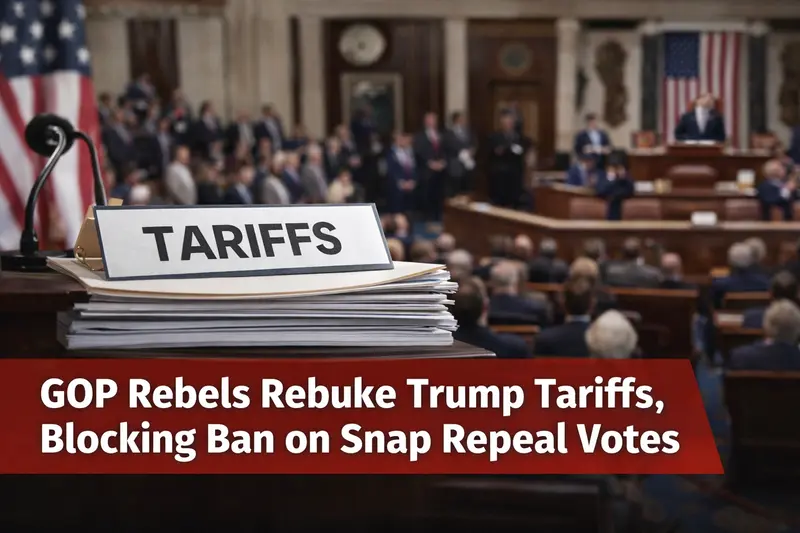
GOP rebels rebuke Trump tariffs, blocking ban on snap repeal votes
A few GOP rebels on Tuesday issued a stunning rebuke of President Trump’s tariff regime, joining with Democrats to vote down legislation that would have banned lawmakers from calling snap votes to repeal the tariffs.
The House voted 214-217 to block the rule, which would have also teed up votes for other legislation later this week.
Republican Reps. Kevin Kiley (Calif.), Don Bacon (Neb.), and Thomas Massie (Ky.) opposed the rule — opening the door for a wave of snap repeal votes, the first expected as soon as Wednesday.
Speaker Mike Johnson (R-La.) tried to win them over, delaying the vote from 1:30 p.m. to 8:30 p.m., but failed.
Rep. Bacon wrote on X:
“I don’t like putting the important work of the House on pause, but Congress needs to be able to debate on tariffs… It’s time for Congress to reclaim that responsibility.”
The blocked rule would have reinstated a ban on calling snap votes to repeal the national emergency authority behind Trump’s tariffs through the end of July.
With the rule defeated, Democrats can now push forward with their plan to force a vote on repealing Trump’s national emergency declaration on tariffs for Canada.
Rep. Gregory Meeks (D-N.Y.), chair of the House Foreign Affairs Committee, is expected to force that vote as early as Wednesday.
A similar resolution could pass the Senate as well. In October, four Republicans — Mitch McConnell, Rand Paul, Susan Collins, and Lisa Murkowski — joined all Democrats to vote to terminate Trump’s tariffs on Canada.
Speaker Johnson argued the pause was needed while waiting for a Supreme Court ruling on challenges to Trump’s national emergency declarations:
“The rationale is to allow the Supreme Court to rule on the pending case that everybody’s watching,” Johnson said.
GOP leaders kept the vote open for nearly an hour, flipping a few members — including Rep. Victoria Spartz — but not enough to overcome the defections.
Massie said leadership “did not reach out at all” to try to change his mind:
“Such an inconvenience,” he joked. “My voting card has only been in those machines like, three times all week.”
He noted that even if Democrats force repeated repeal votes, Trump would simply veto them, keeping the tariffs in place.
Trump used national emergency powers to implement his global tariffs and specific tariffs on China, Mexico and Canada. The National Emergencies Act allows Congress to repeal such emergencies using expedited joint resolutions after a set number of calendar days.
Last year, GOP leaders repeatedly inserted language into rules that blocked those calendar days from counting, preventing members from forcing repeal votes.
That protection expired in January.
Tuesday’s vote marks a major win for traditional free-market conservatives who have long opposed Trump’s tariffs.
David Williams, president of the Taxpayers Protection Alliance, said:
“It is encouraging to see the House finally reassert its authority over trade policy… sweeping tariffs have raised prices, disrupted operations, and created economic uncertainty.”
Later Tuesday night, the House Rules Committee moved the unrelated bills blocked by the rule into another rule tied to the SAVE America Act, ensuring they can still advance.
What's your reaction?
0

AWESOME!
0

LOVED
0

NICE
0

LOL
0

FUNNY
0

EW!
0

OMG!
0

FAIL!
Recent News




Comments
Leave a Reply