


Technology
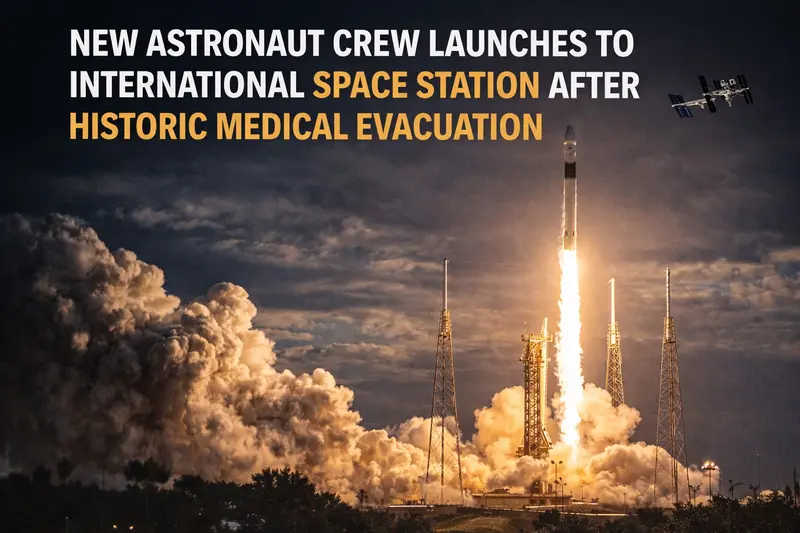
New Astronaut Crew Launches to International Space Station After Historic Medical Evacuation
📍 CAPE CANAVERAL, Fla.
A new team of astronauts has successfully launched toward the International Space Station (ISS), replacing crew members who returned to Earth early following NASA’s first-ever medical evacuation in orbit.
A SpaceX Falcon 9 rocket lifted off from Cape Canaveral Space Force Station, carrying four astronauts on what is expected to be an eight- to nine-month mission extending into the fall. The incoming crew includes American astronauts Jessica Meir and Jack Hathaway, France’s Sophie Adenot, and Russian cosmonaut Andrei Fedyaev.
They are scheduled to arrive at the orbiting laboratory on Saturday, restoring the station to full staffing after last month’s unexpected emergency return.
A Historic First for NASA
The evacuation marked a historic moment in spaceflight. For the first time in 65 years of human space exploration, NASA cut short a mission due to medical concerns.
While NASA has not disclosed the identity or condition of the affected astronaut, officials confirmed that all four returning crew members were transported directly to a hospital after splashdown in the Pacific Ocean near San Diego.
Despite the medical incident, NASA stated that no additional medical screenings were required for the new crew before launch. Equipment already aboard the ISS — including an ultrasound machine used in research — was utilized during the emergency.
Deputy program manager Dina Contella explained that while NASA continues upgrading medical capabilities aboard the ISS, certain health situations require astronauts to return to Earth.
“Friday the 13th” Brings Good Fortune
After reaching orbit, SpaceX Launch Control radioed the crew:
“It turns out Friday the 13th is a very lucky day.”
Commander Jessica Meir responded:
“That was quite a ride.”
NASA had temporarily paused spacewalks and some research activities while awaiting the arrival of the replacement crew. Three astronauts — one American and two Russians — maintained station operations during the interim period.
Preparing for Moon and Mars Missions
The new crew will participate in advanced research critical for future deep-space exploration, including:
-
Testing a water filtration system designed to convert drinking water into emergency IV fluid
-
Using an AI-assisted ultrasound system that reduces reliance on ground-based experts
-
Conducting blood clot studies through jugular vein scans
-
Practicing simulated moon-landing procedures
These tests come at a pivotal time, as NASA prepares for Artemis II, the first crewed lunar mission in over 50 years.
Jessica Meir, who previously participated in the first all-female spacewalk in 2019, expressed excitement about the Artemis program:
“It’s so cool to be an astronaut now. We’re right on the edge of returning to the moon.”
Artemis II and the Road Ahead
NASA Administrator Jared Isaacman confirmed continued testing of the Space Launch System (SLS) rocket that will power Artemis II. Following recent fueling tests and seal replacements, additional testing is underway before a launch date is finalized.
The earliest potential launch window for Artemis II is currently projected for early March, pending successful evaluations.
Meanwhile, SpaceX continues preparing its Starship launch infrastructure at Kennedy Space Center — a key component in NASA’s long-term lunar ambitions.
🌌 A New Era of Space Exploration
With the ISS back at full strength and lunar missions on the horizon, NASA and its international partners are entering a new phase of human spaceflight.
Longer missions, advanced medical technologies, and deep-space preparations are shaping the future — not just for orbit, but for the moon and eventually Mars.
What's your reaction?
0

AWESOME!
0

LOVED
0

NICE
0

LOL
0

FUNNY
0

EW!
0

OMG!
0

FAIL!
Recent News




Comments
Leave a Reply