


Business
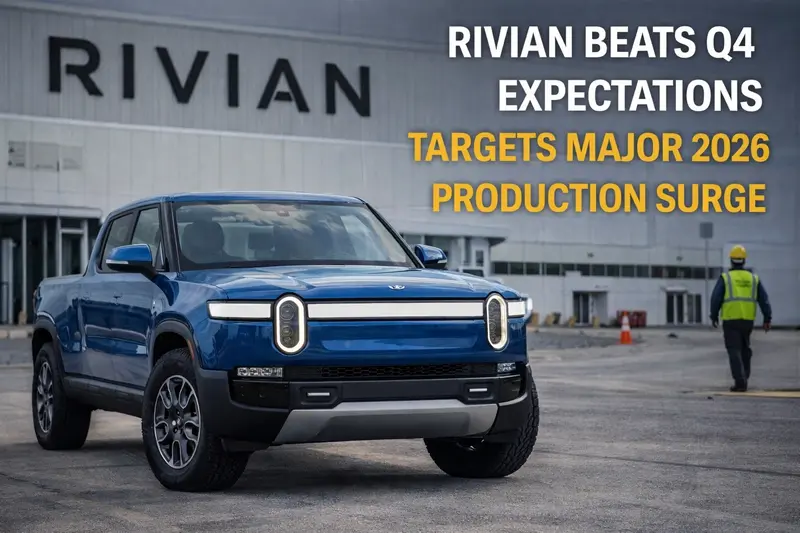
Rivian Beats Q4 Expectations and Targets Major Production Surge in 2026
Rivian Outperforms in Fourth Quarter
Electric vehicle maker Rivian Automotive (RIVN) exceeded analysts’ expectations for the fourth quarter, reporting stronger-than-expected earnings and revenue as it prepares for a transformative year ahead.
For Q4, Rivian posted:
-
Loss per share: 54 cents (better than the expected 68-cent loss)
-
Revenue: $1.29 billion (above the expected $1.26 billion)
The company also achieved its first annual gross profit, marking a key milestone for investors closely monitoring Rivian’s path toward long-term profitability.
2026 Guidance: A Big Jump in Deliveries
Rivian announced that it expects to deliver between 62,000 and 67,000 vehicles in 2026, representing a 47% to 59% increase compared with 2025.
This growth is expected to be driven largely by the launch of the R2 SUV, Rivian’s next-generation midsize electric vehicle. CEO RJ Scaringe said the R2 could become the majority of the company’s production volume by the end of 2027.
The R2, expected to start around $45,000, is designed to:
-
Cut material costs significantly
-
Reduce production complexity
-
Expand demand to a broader consumer market
Deliveries of the R2 are expected to begin in the second quarter.
Profitability Still a Work in Progress
Despite the strong quarterly performance, Rivian cautioned that it will continue posting losses as it ramps up production.
For 2026, the company forecasts:
-
Adjusted pre-tax losses: $1.8 billion to $2.1 billion
-
Capital expenditures: $1.95 billion to $2.05 billion
Rivian reported a net loss of $3.6 billion last year, an improvement from the previous year’s $4.75 billion loss.
Executives described 2025 as a “foundational year,” while 2026 is expected to mark an “inflection point” as production scales.
Strong Liquidity Position
Rivian ended the fourth quarter with $6.59 billion in total liquidity, including nearly $6.1 billion in cash and short-term investments — providing crucial financial flexibility as it ramps up R2 production at its Illinois factory.
Investors responded positively, sending shares higher in premarket trading following the announcement.
The Road Ahead
Rivian has made important progress with its R1 pickup and SUV models, but demand for higher-priced EVs has slowed across the industry. The success of the more affordable R2 will likely determine whether the company can transition from growth-focused spending to sustained profitability.
As competition in the EV market intensifies, Rivian’s 2026 execution will be closely watched by investors and analysts alike.
What's your reaction?
0

AWESOME!
0

LOVED
0

NICE
0

LOL
0

FUNNY
0

EW!
0

OMG!
0

FAIL!
Recent News




Comments
Leave a Reply