

Politics
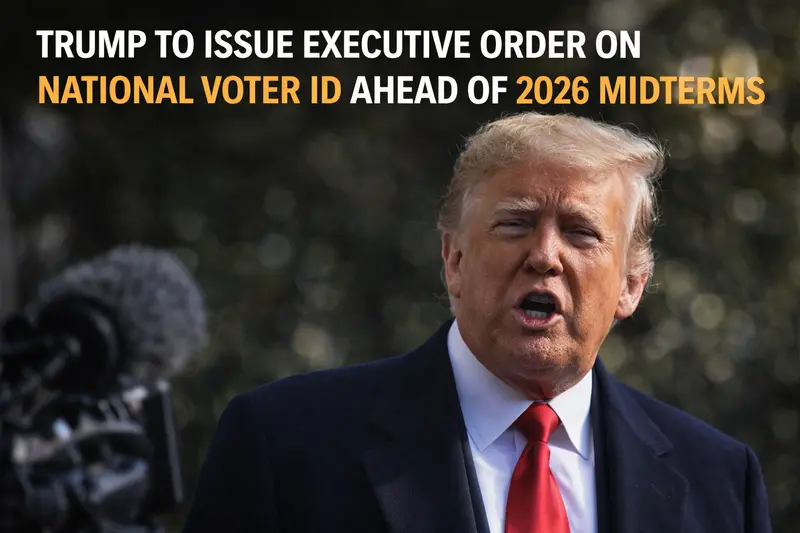
Trump Says He Will Issue Executive Order on National Voter ID Ahead of Midterms
President Donald Trump announced Friday that he plans to issue an executive order outlining what he calls the “legal reasons” for implementing national voter identification requirements across the United States.
In a series of posts on Truth Social, Trump said he wants voter ID rules in place before the 2026 midterm elections, even as legislation mandating such requirements faces strong resistance in Congress.
“The Democrats refuse to vote for Voter I.D., or Citizenship. The reason is very simple — they want to continue to cheat in elections,” Trump wrote, arguing that voter identification laws are necessary to protect election integrity.
He added that if Congress fails to pass legislation, he believes there are legal pathways available for executive action. “There will be Voter I.D. for the Midterm Elections, whether approved by Congress or not,” Trump stated.
SAVE America Act Faces Senate Hurdles
The debate intensified earlier this week when the House narrowly advanced the SAVE America Act, a Republican-backed bill requiring proof of citizenship to register to vote and a government-issued photo ID to cast a ballot.
The bill passed the House in a tight vote but now moves to the Senate, where it faces significant challenges. Republicans hold 53 seats, meaning they would need support from several Democrats to overcome a filibuster.
Senate Minority Leader Chuck Schumer has already labeled the proposal “dead on arrival,” arguing that it could make voting more difficult for millions of Americans.
Critics of the legislation say it risks disenfranchising voters, particularly women whose birth certificates may not reflect their married names, as well as elderly and low-income individuals who may lack updated identification documents.
Growing Political Tensions
The issue of voter ID has increasingly dominated political discourse, especially among conservative lawmakers and online commentators who argue that stricter identification rules are necessary to prevent election fraud.
Democrats and voting-rights advocates, however, fear that executive action on federal elections could trigger legal battles and constitutional disputes. Under the U.S. Constitution, states maintain primary authority over how elections are conducted.
Trump has also revived broader election concerns in recent weeks, including launching federal inquiries related to past election results and suggesting that national standards are needed to ensure uniformity.
What Happens Next?
If Trump proceeds with an executive order, it would almost certainly face immediate legal challenges. Constitutional scholars note that while Congress has authority over federal elections, states retain control over many election procedures.
With the 2026 midterms approaching, the debate over voter ID is likely to intensify, setting the stage for a major political and legal showdown over election laws in the United States.
What's your reaction?
0

AWESOME!
0

LOVED
0

NICE
0

LOL
0

FUNNY
0

EW!
0

OMG!
0

FAIL!
Recent News




Comments
Leave a Reply